The debate is framed wrongly. It is not "custom-built" versus "branded", but what you pay on top of the hardware, and whether that premium serves you.
What you pay a manufacturer for
With a branded PC, the price covers the hardware plus four things:
- A contractual warranty, sometimes on site, with a number to call.
- A frozen catalogue: the same part number available for two years, valuable for a homogeneous fleet.
- Certifications required by some business software or public tenders.
- A margin, often above 20% on mid-range configurations.
Those four have real value for a 200-person company with an IT department. For a fifteen-person SME, only the first two genuinely count.
Where custom wins
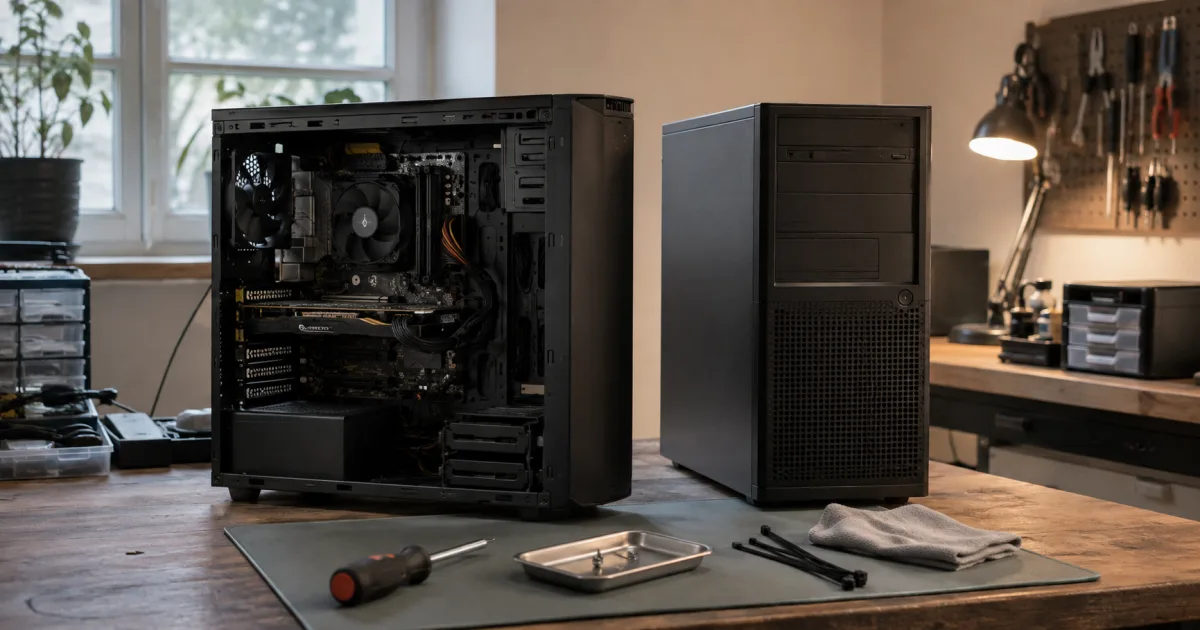
For the same budget, a custom-built machine consistently gets better components exactly where they matter:
- Storage. Manufacturers economise on the SSD; it is invisible on the spec sheet and very visible in use.
- The power supply. The most frequently sacrificed component, and the one that takes the others down with it.
- Cooling. A quiet machine is not quiet by accident, and a machine that runs hot throttles itself.
- Headroom. Two free memory slots and a real case let you double the RAM in three years instead of rebuying.
On a demanding workstation (CAD, video editing, development, computation) the performance gap at identical budget commonly reaches 30 to 40%.
Where the brand is still right
To be clear, assembly is not the universal answer:
- Laptops. Assembly makes no sense; the manufacturer ecosystem is unbeatable there.
- Very homogeneous fleets. Fifty identical machines to deploy and administer: a frozen catalogue is worth the margin.
- Sites with no technical skill on hand and no local provider. A single support number has value.
- Markets that require it. Some tenders mandate certifications only a manufacturer supplies.
The warranty question
This is the instinctive objection, and it deserves a precise answer. On a custom-built machine, each component keeps its own manufacturer warranty, often longer than the whole-machine one: three to five years on an SSD, two to three on a quality power supply.
What changes is who you deal with. Without a provider, you handle returns part by part: tedious. With a local provider holding spares, you are back up faster than a repair-centre shipment would allow.
The arithmetic, in practice
For a standard office machine, the difference is slim and a branded PC remains a perfectly sound choice.
For a workstation, compare at equal performance, not equal price: configure the custom-built machine you want, ask the manufacturer for its real equivalent (same processor, same memory, same SSD class) and look at the gap. It is rarely under 25%.
And ask the question that actually decides it: who turns up when it breaks, and how fast? That answer matters more than the badge on the case.